
Field guide · Rivell
Concealed weapons detection in New Jersey, New York and Pennsylvania
Rivell is headquartered at 900 Hollydell Ct. in Sewell, New Jersey, and plans, installs and supports concealed weapons detection across New Jersey, New York and Pennsylvania, with projects nationwide. Each state has its own school security funding rules and expectations for healthcare facilities. This page summarizes the public programs most relevant to entrance screening so your planning starts on solid ground.
Rivell Concealed Weapons Detection team
6 min read
Last reviewed: November 2026
Illustrative image
Our disclosure
Summaries reflect the cited public documents as of November 2026 and are not legal or grant advice.
Key takeaways
Funding and approval rules differ by state and change over time. Confirm eligibility with the program office before you budget, keep screening inside a documented risk assessment, and plan privacy and procurement reviews from day one.
New Jersey: schools
New Jersey’s Securing Our Children’s Future Bond Act funded a School Security Grants program administered by the New Jersey Department of Education. Its most recent round made $75,000,000 available, was 100% state funded up to each district’s allocation, and ran a 24-month grant period from May 1, 2024 to April 30, 2026. [S14]
Eligibility was tied to Alyssa’s Law: the round was open to public school districts that had obtained a certification of compliance with Alyssa’s Law for all of their school buildings from the New Jersey Schools Development Authority, with one application per district. [S14][S15] Districts planning screening should check NJDOE’s grant opportunities for any new round rather than assume past funding is still available.
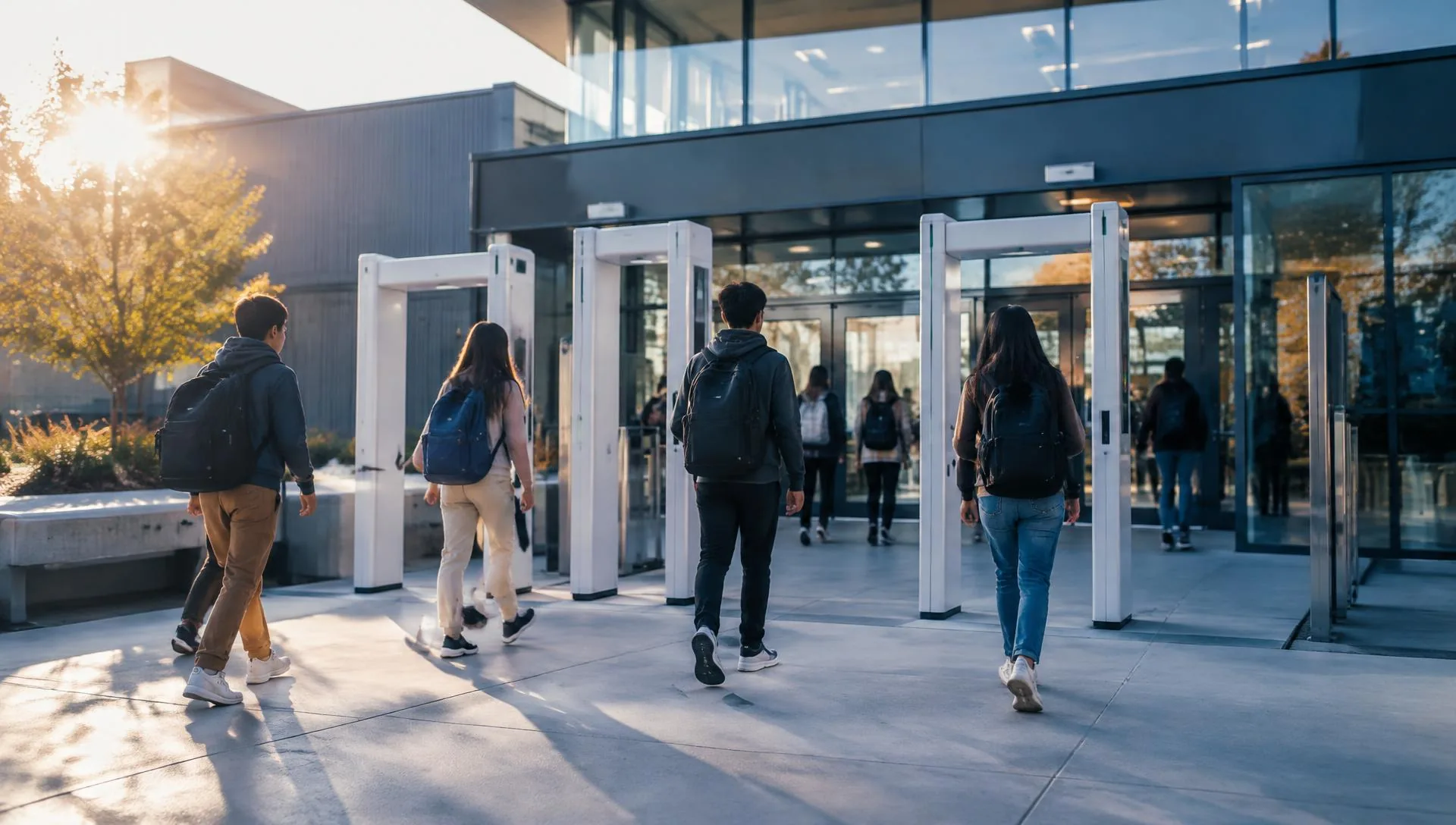
For a New Jersey district, concealed weapons detection usually sits alongside panic alarms, access control and cameras. We start with which entrances students actually use, arrival peaks, how backpacks and instruments are handled and how the program is explained to families.
New Jersey: hospitals and healthcare
New Jersey’s Violence Prevention in Health Care Facilities Act requires covered facilities, including licensed general and special hospitals and nursing homes, to run a violence prevention program with a committee in which at least half of the members are health care workers who provide direct patient care or otherwise have contact with patients. [S16]
The law requires an annual comprehensive violence risk assessment that considers, among other things, the facility’s layout, access restrictions, communication and alarm devices, and the impact of staffing including security personnel. [S16] Entrance screening is one option a committee can weigh within that assessment. If it is chosen, it must be designed around emergency care, clinical overrides and patients with implanted devices.
New York: schools
New York’s Smart Schools Bond Act includes a category for installing high-tech security features in school buildings and on campuses, including video surveillance, emergency notification systems and physical access controls. Security projects go through a preliminary review with NYSED’s Office of Facilities Planning, which decides between standard and streamlined review. [S17] A district’s Smart Schools Investment Plan must be approved before it bids, contracts or spends funds, or the costs are not eligible for reimbursement. [S18]
Two New York rules deserve attention early. NYSED states it is not currently approving plans that include facial recognition technology or other similar self-learning analytic software, and districts with High-Tech Security spending must submit an updated Statement of Assurances. [S18] Separately, the Commissioner’s 2023 determination prohibits New York schools from purchasing or using facial recognition technology. [S19]
Concealed weapons detection is not facial recognition, but some systems use AI-powered signal analytics and capture images of people who cause alerts. [S4] A New York district considering Smart Schools funds should confirm with NYSED how a specific screening system will be treated before budgeting, and document its privacy review.
Pennsylvania: schools
Pennsylvania’s Commission on Crime and Delinquency (PCCD) runs noncompetitive, formula-based School Safety and Mental Health Grants. The FY26-27 announcement made $138,779,000 in state funding available; school districts receive a $100,000 base plus an amount based on Adjusted Average Daily Membership, and other eligible school entities receive $70,000. [S20]
Pennsylvania ties physical security spending to baseline criteria. School entities must meet the current Level 1 physical security baseline criteria before using these funds for most other eligible physical security activities; the criteria were updated in June 2026. [S20][S22] PCCD’s list of eligible project activities includes security planning and the purchase of security-related technology, which may include metal detectors. [S21]
For a Pennsylvania school entity, a screening project is easiest to justify when it follows from a completed physical security assessment and documents how the entrance plan, staffing and policies meet the baseline criteria.
Venues, workplaces and government buildings across the region
Outside schools and hospitals, the planning questions are similar across all three states: which entrances will be screened, how peaks will be handled, where secondary screening happens and how the policy is communicated. CISA’s Public Venue Security Screening Guide recommends a written screening policy that is applied uniformly. [S3]
If federal preparedness grants are involved, DHS lists walk-through screening under FEMA Authorized Equipment List reference 15SC-00-PPSS, and Section 889 rules make costs for covered telecommunications and video surveillance equipment unallowable for grant funding. [S11][S4] DHS also lists the Evolv Express platform on GSA schedule 47QSWA18D003K. [S4]
How Rivell supports projects in NJ, NY and PA
Our team is based in Sewell, New Jersey. For projects across the region we run the same process: a site survey of your entrances and current screening, a design for lanes, queueing, secondary screening, signage and accessibility, installation and integration with video and access control, acceptance testing, written procedures, training and ongoing support.
We do not provide legal or grant advice, and we will not tell you a program covers your project unless the program office confirms it. What we can do is give you a clear scope, a realistic staffing picture and documentation that supports your own application or board approval.
Frequently asked questions
Does Rivell provide concealed weapons detection outside New Jersey?
Yes. Rivell serves New Jersey, New York and Pennsylvania, with projects nationwide.
Can school security grants pay for weapons detection?
It depends on the program and the current rules. Pennsylvania’s PCCD eligible activities include security-related technology such as metal detectors once Level 1 baseline criteria are met; New Jersey and New York programs have their own eligibility and approval requirements. Confirm with the program office before budgeting. [S20][S21][S14][S17]
Is concealed weapons detection the same as facial recognition?
No. Concealed weapons detection screens for objects, not identities. New York prohibits facial recognition in schools, so districts there should confirm how any AI-assisted system will be treated. [S19][S18]
Is this page legal or grant advice?
No. It summarizes public program documents as of November 2026. Rules and funding change, so always confirm with the agency that runs the program.
Sources
- [S3]CISA, Public Venue Security Screening Guide
- [S4]DHS SAVER, Walk-Through Weapons Screening Systems for Mass Casualty Threats — September 2024
- [S11]DHS S&T TechNote, Walk-Through Screening Systems for Mass Casualty Threats — May 2024
- [S14]NJDOE, Securing Our Children’s Future Bond Act School Security Grant Instructions (Round 3)
- [S15]N.J.A.C. 6A:26A, Securing Our Children’s Future Bond Act
- [S16]New Jersey P.L. 2007, c.236, Violence Prevention in Health Care Facilities Act
- [S17]NYSED, Smart Schools Bond Act Implementation Guidance — November 2024
- [S18]NYSED, About the Smart Schools Bond Act
- [S19]NYSED, Commissioner’s Determination on Biometric Identifying Technology in Schools — September 27, 2023
- [S20]PCCD, FY26-27 School Safety and Mental Health Grants Funding Announcement
- [S21]PCCD, School Safety and Security Grant Program Eligible Project Activities
- [S22]PCCD, Physical Security Baseline Criteria
Continue exploring
Request a site survey
Start with your entrances, your people and a practical plan.