
Field guide · Rivell
Concealed weapon detection vs. metal detectors
Both screen people for weapons at an entrance. The differences are in how they sense, what they ask of visitors, and what it takes to run them well.
7 min read
Last reviewed: November 2026
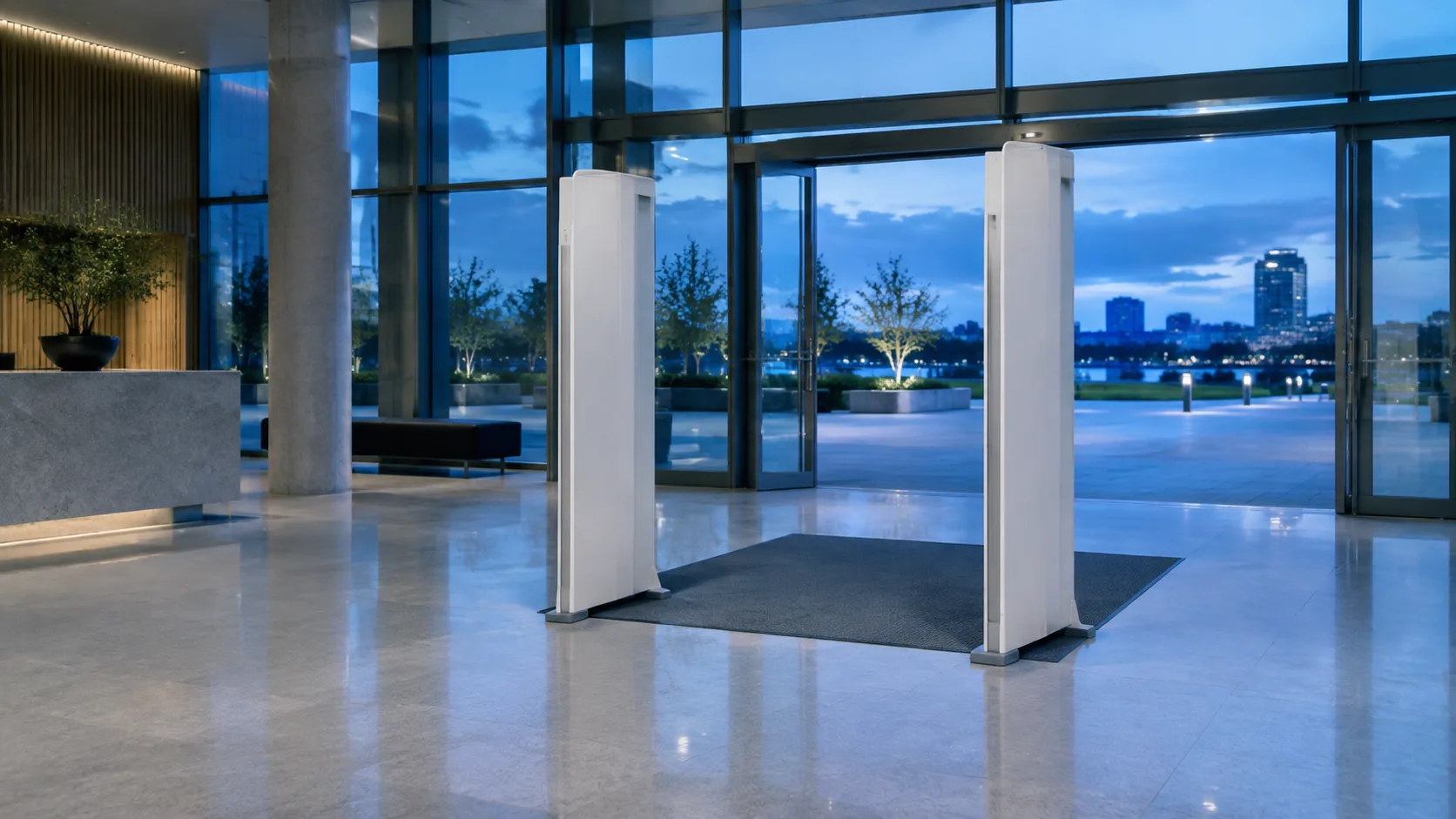
Illustrative image
Key takeaways
Many modern concealed weapons detection systems are themselves built on metal detection, enhanced with signal analytics and object localization. [S4] The practical differences show up in divestment, nuisance alarms, how alerts are resolved and visitor experience. Neither approach detects every weapon; standards, settings and operations matter more than labels.
The short answer
A conventional walk-through metal detector (WTMD) alarms when it senses metal above a threshold, which is why keys, phones, belts and coins often need to go in a tray. Modern concealed weapons detection systems — including the Evolv Express platform behind Motorola Solutions Concealed Weapons Detection — also use electromagnetic sensing, but add analysis of magnetic signatures and AI-based signal analytics to separate likely threats from many common items, and show the operator where on the person the item is. [S4] That can mean less divestment and more targeted secondary checks. It does not mean the system is infallible.
For a buyer, the label is less useful than the complete screening process. Ask what visitors must remove, what creates an alert, what the operator sees and how staff resolve it. Those questions turn a broad technology comparison into a practical entrance comparison. A lane cannot be judged separately from the policies and people around it.
How each technology senses
Active walk-through metal detectors generate a magnetic field between two panels and detect both ferrous and non-ferrous metals. [S4] Their operating principle differs from passive metal detectors, even though both are commonly discussed under the same broad label.
Passive metal detectors, or magnetometers, have no transmitter. They sense disturbances in the earth's magnetic field and primarily detect ferromagnetic metals, so non-ferrous items can be difficult for most of them to detect. [S4] Ask which detection principle a proposed product actually uses rather than assuming every portal responds to the same objects.
AI-assisted electromagnetic screening, including the Evolv Express platform, uses active continuous-wave sensing in the extremely-low-frequency range with magnetic-signature analysis and AI-powered signal analytics. [S4] The software is part of the distinction, but the underlying screening remains electromagnetic sensing.
Imaging systems, including millimeter wave portals and stand-off systems, look at how objects reflect or emit energy and can detect non-metallic objects too. [S4] They belong in a separate category when comparing operating models. A guide that mixes these systems without explaining their physics makes it harder to choose an approach for your site.
Comparison table
Read the table as a comparison of operating approaches, not a guarantee for any model. Verify current specifications and the settings under which a proposed system was evaluated.
| Consideration | Conventional WTMD | AI-assisted CWD |
|---|---|---|
| What visitors do | Often divest keys, phones and belts into trays | Most walk through with everyday items in place |
| Typical alarm behavior | Alarms on metal above a threshold; many nuisance alarms in everyday crowds | Designed to ignore many common items; large or dense metal objects still alert |
| Alert detail | Many models localize by zone. [S4] | Image-aided alert showing location on a photo of the person. [S4] |
| Secondary screening | Required | Required; aims to make it targeted |
| Bags | Separate bag search or X-ray | Can screen many bags carried through, with policies for large electronics |
| Standards | ASTM F3566-22. [S5] | Ask what testing supports claims |
| Cost structure | Lower equipment cost; DHS reported $5,000–$19,000 for four of ten metal-detection systems surveyed; prices vary by model and vendor. [S4] | Higher equipment or subscription cost; staffing drives total cost for both |
Comparison table
- What visitors do
- Conventional WTMD
- Often divest keys, phones and belts into trays
- AI-assisted CWD
- Most walk through with everyday items in place
- Typical alarm behavior
- Conventional WTMD
- Alarms on metal above a threshold; many nuisance alarms in everyday crowds
- AI-assisted CWD
- Designed to ignore many common items; large or dense metal objects still alert
- Alert detail
- Conventional WTMD
- Many models localize by zone. [S4]
- AI-assisted CWD
- Image-aided alert showing location on a photo of the person. [S4]
- Secondary screening
- Conventional WTMD
- Required
- AI-assisted CWD
- Required; aims to make it targeted
- Bags
- Conventional WTMD
- Separate bag search or X-ray
- AI-assisted CWD
- Can screen many bags carried through, with policies for large electronics
- Standards
- Conventional WTMD
- ASTM F3566-22. [S5]
- AI-assisted CWD
- Ask what testing supports claims
- Cost structure
- Conventional WTMD
- Lower equipment cost; DHS reported $5,000–$19,000 for four of ten metal-detection systems surveyed; prices vary by model and vendor. [S4]
- AI-assisted CWD
- Higher equipment or subscription cost; staffing drives total cost for both
Nuisance alarms and divestment
Every alarm on a harmless object costs time and goodwill. Reducing divestment — the need to empty pockets and remove items — is the main experience gain modern systems aim for. But sensitivity is a dial, not a free lunch: raising it catches more potential threats and causes more alerts on harmless items, and lowering it does the reverse. Public reporting on school deployments has illustrated that trade-off. [S7] Choose settings with your risk assessment, test them in your environment, and revisit them.
Make the evaluation specific to your entrance. Ask about laptops, binders, instruments and other items your visitors carry, and agree how staff will handle those items. A comparison is meaningful only when both options are assessed against the same visitor needs and screening policy. Less divestment is an experience goal; it does not remove the need for secondary screening.
Throughput: brochure vs. reality
DHS explains that a standard-compliant WTMD should support at least 3,000 people per hour for larger weapons (1,500 for smaller weapons) under the standard's technical definition of maximum throughput, but that real-world "effective throughput" is lower and depends on checkpoint design, procedures, lanes and divestment rules. It also cautions that claims like "2–3 times the throughput of conventional WTMDs" are imprecise. [S4] The lesson: compare complete entrance designs, not spec sheets.
Ask what staffing and secondary screening arrangement accompanies a quoted maximum. The entrance plan should explain where people wait, where alerted visitors are checked and how that process connects back to the lane. Without those details, a throughput comparison leaves out the work that makes screening useful in practice.
Standards and evidence
ASTM F3566-22 is the current performance standard for walk-through metal detectors, specifying detection testing across object size classes and discrimination tests using exemplar items such as a phone, belt buckle and watch. [S5][S4] DHS notes it supersedes NIJ Standard-0601.02 (2003), which some manufacturers still cite. [S6][S4] DHS also notes that the detection probability of a system should be stated for a particular threat class, at a particular throughput, with a statistical confidence interval — and that most product specifications omit the confidence interval. [S4] Ask vendors for exactly that.
Evidence should describe the conditions of the test, not just the outcome. Match the stated threat class, sensitivity and throughput to the proposed use. When a supplier cannot explain what a comparison measures, do not turn that comparison into a promise to your community. Ask for the missing information before selecting equipment.
Which is right for your site?
Traditional WTMDs with bag search or X-ray can be the right choice where volume is modest, divestment is acceptable, or budgets are tight. AI-assisted concealed weapons detection is worth evaluating where arrival peaks are intense, visitor experience matters, and you want alerts integrated with video and operations. Many sites use both. A site survey makes the trade-offs concrete.
Start with the doors you will screen, the arrival pattern and the people who will operate the entrance. Compare acquisition, preparation, integration, training and support alongside staffing. The goal is not to buy the most impressive label; it is to choose a complete screening approach that your team can operate responsibly.
Keep the comparison tied to a decision your team can explain. Record the visitor items, settings, staffing and secondary process assumed for each option. If one proposal expects divestment and another does not, make that distinction visible instead of treating their advertised throughput as directly comparable.
Before committing, ask the vendor and integrator to explain how the entrance would operate when an alert occurs. Identify who handles the check, where it happens and how the process returns to normal screening. Discuss accessibility and the communication visitors receive. Those questions help leadership evaluate the complete approach, including the work that remains for trained people.
Revisit the same requirements when reviewing the evaluation. A documented limitation is useful information for choosing settings and procedures; it should not disappear from the recommendation simply because a demonstration was impressive. The final choice should connect the evidence, your entrance design and the resources you will use to operate it.
Questions about this topic
Is concealed weapon detection more accurate than a metal detector?
Accuracy depends on threat type, settings and environment; be wary of blanket claims — a 2024 federal order bars one vendor from unsupported accuracy comparisons with metal detectors. [S7]
Can I keep my existing metal detectors?
Yes; many programs combine technologies.
Continue exploring

Request a site survey
Start with your entrances, your people and a practical plan.
Sources
- [S4]DHS SAVER, Walk-Through Weapons Screening Systems for Mass Casualty Threats — September 2024
- [S5]ASTM F3566-22, Walk-Through Metal Detector Performance Specifications and Test Methods
- [S6]NIJ Standard-0601.02, Walk-Through Metal Detectors — 2003
- [S7]FTC v. Evolv Technologies Holdings, Stipulated Order — November 26, 2024