
Field guide · Rivell
Weapons detection for schools: a practical guide for districts
School leaders face pressure to act quickly after every incident. This guide helps districts decide whether, where and how to screen — and how to do it in a way students, staff and families can trust.
Rivell Concealed Weapons Detection team
7 min read
Last reviewed: November 2026
Illustrative image
Key takeaways
Screening is one layer of a school safety plan, not the plan. Entrance design and staffing determine success. Set honest expectations with your community. Evaluate on site before committing.
Start with your safety plan
Begin with the district's safety plan rather than a product shortlist. Threat assessment teams, access control, visitor management, communications and emergency drills come first; screening should fit those layers. CISA's School Safety resources offer a place to begin the broader discussion. [S12] Review how students, staff and visitors currently enter and which responsibilities sit with school leaders, facilities and security.
Agree what the district wants screening to accomplish and where it belongs. A main entrance, morning arrival route and athletics event may need different procedures. Identify how doors outside the screening process will remain controlled. Involve the people who will operate the entrance so the plan reflects daily school life, not only an equipment demonstration.
Morning arrival is the hard part
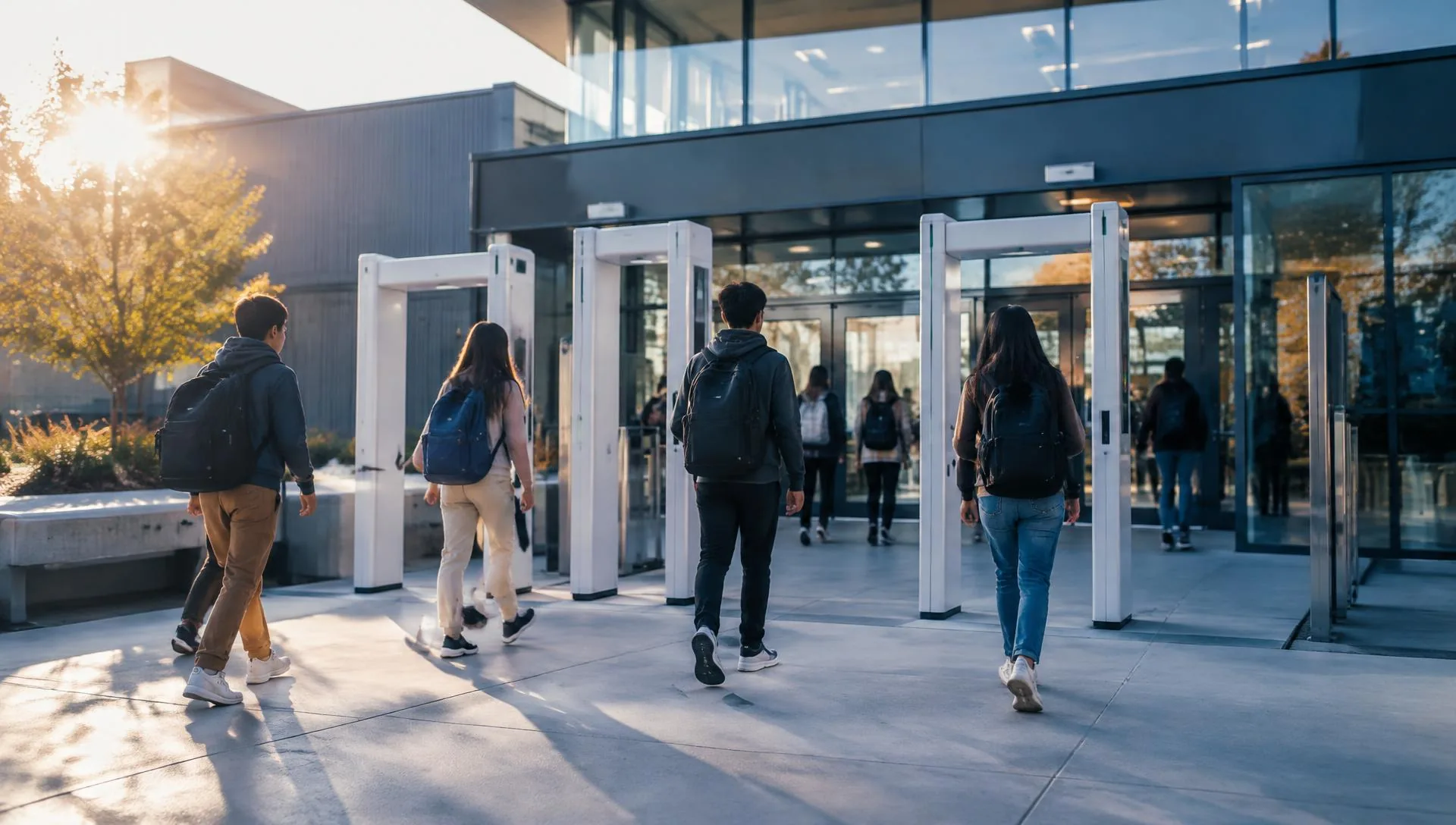
Arrival peaks compress hundreds of students into minutes, with buses arriving in waves and weather affecting where queues can wait. Backpacks, laptops, binders and instruments arrive together. Review that whole flow before selecting lane locations. Ask where students approach, how they understand the next step and where a secondary check can happen outside the main path.
Plan lanes per entrance, queue space and staffing roles together. Consider staggered entry where it fits the school schedule, and review how bus arrivals connect to the doors being screened. Keep an accessible route clear. A drawing should show more than the unit footprint: it should show the people waiting, the staff positions and the handoff when an alert occurs.
Walk through the proposed process with the arrival team. Discuss a busy morning and a different after-school event, including what changes in staffing or door use. Write down the assumptions so the evaluation and procurement conversation follow the same entrance plan.
Students' items and nuisance alerts
Laptops, binders and other dense everyday items are a common source of alerts, so plan a bag procedure and test it with real student loads. Do not assume that a general demonstration answers how your students' everyday loads will behave. Bring representative belongings to an evaluation and ask how the proposed settings and bag procedure handle them.
A district may choose a procedure such as carrying laptops separately. Whatever the choice, make it simple to explain and practical for students moving from buses or outdoor queues. Review where items go, who checks them and how students recover their belongings. Avoid a process that leaves staff making different decisions at different doors.
Test the complete procedure, not merely whether someone can walk through a lane. Review what creates an alert, how it is resolved and how the student returns to the arrival flow. Use the observations to refine staffing and communication before committing to the wider program.
Students with disabilities and medical devices
Review ADA lane width and the alternative screening procedure as part of design. DHS includes accessibility and medical-device considerations in its survey. [S4] Coordinate with school nurses and the district's 504/IEP teams so the process respects existing student needs. An alternative should be clear to staff and available without a public discussion of personal medical information.
Consider the route as well as the lane itself. Students need a usable approach, a clear path to any secondary area and a respectful return to normal entry. Staff should know how to explain alternatives calmly and who to contact when a question falls outside their training. Make those responsibilities part of the written procedure.
Communication and trust
Explain why the district is considering screening and how it fits the wider safety plan. Describe what students will experience at arrival, which belongings need special handling and what happens after an alert. An alert is a reason for trained people to assess an item, not a conclusion about a student. Use that distinction consistently in family and staff communication.
Explain what data is captured and retained for the proposed configuration. Invite questions about accessibility, secondary checks and daily arrival before the process is introduced. Keep the explanation practical and avoid promising that screening keeps all weapons out. No technology removes the need for trained people, controlled doors and a response plan.
Give staff a shared explanation so families do not receive conflicting answers. Describe limitations alongside the benefits and update communication when procedures change. Trust depends on an understandable process and realistic expectations, not on an absolute promise.
Procurement lessons
The 2024 FTC order regarding Evolv included an option for certain K-12 customers to cancel contracts and prohibits unsupported claims. [S7] For any vendor, put performance expectations, evaluation criteria and termination terms in writing. Ask what evidence supports each proposed benefit and retain the settings and conditions associated with that evidence.
Check grant eligibility before relying on a funding route. [S4] Compare the full operating commitment, including staff, training, site preparation, integration and support. A committee should be able to understand what is included and which responsibilities remain with the district. Request written answers to the buyer's checklist rather than selecting on the strength of a presentation alone.
An on-site evaluation should follow agreed criteria and the actual arrival plan. Include student loads, staff roles and accessibility procedures. If questions remain, record them explicitly and resolve them before expanding the deployment.
After go-live
Review alert data, settings and staffing together. Ask operators what is difficult, which belongings need clearer handling and where queues or secondary checks interrupt arrival. Refine the process with the people who use it, rather than treating installation as the end of the work.
Provide refresher training and a clear way for new staff to learn procedures. Use periodic community updates to explain changes without adding unsupported performance claims. Keep screening connected to the district's safety plan and review whether the entrance process still matches its goals. A site survey is the practical starting point for that continuing work.
Keep the planning record useful after the buying decision. Record the entrance assumptions, the agreed procedures and the people responsible for reviewing changes. When the layout, visitor items or staffing changes, return to those questions rather than assuming the original process still fits. A written plan gives operators and leadership the same starting point for a practical review, without creating a new performance promise.
Before changing the arrival procedure, review it with the staff who greet students, manage buses and supervise secondary checks. Ask whether instructions are clear from the approach and whether a student who needs assistance can reach the alternate route. Discuss how the same explanation will be shared with families and how questions will reach the right team. Keep that review connected to the safety plan and the evaluation criteria. The purpose is to make responsibilities and limits understandable, not to create a promise that every school morning will be identical. Record the decisions so a change of staff does not create a change of policy.
Frequently asked questions
Do schools need screening at every door?
Usually screening is at designated entrances while other doors are controlled.
Can students keep laptops in bags?
It depends on settings and procedure; test it.
How long does deployment take?
It depends on survey, design and procurement; we give a schedule after the survey.
Continue exploring
Request a site survey
Start with your entrances, your people and a practical plan.